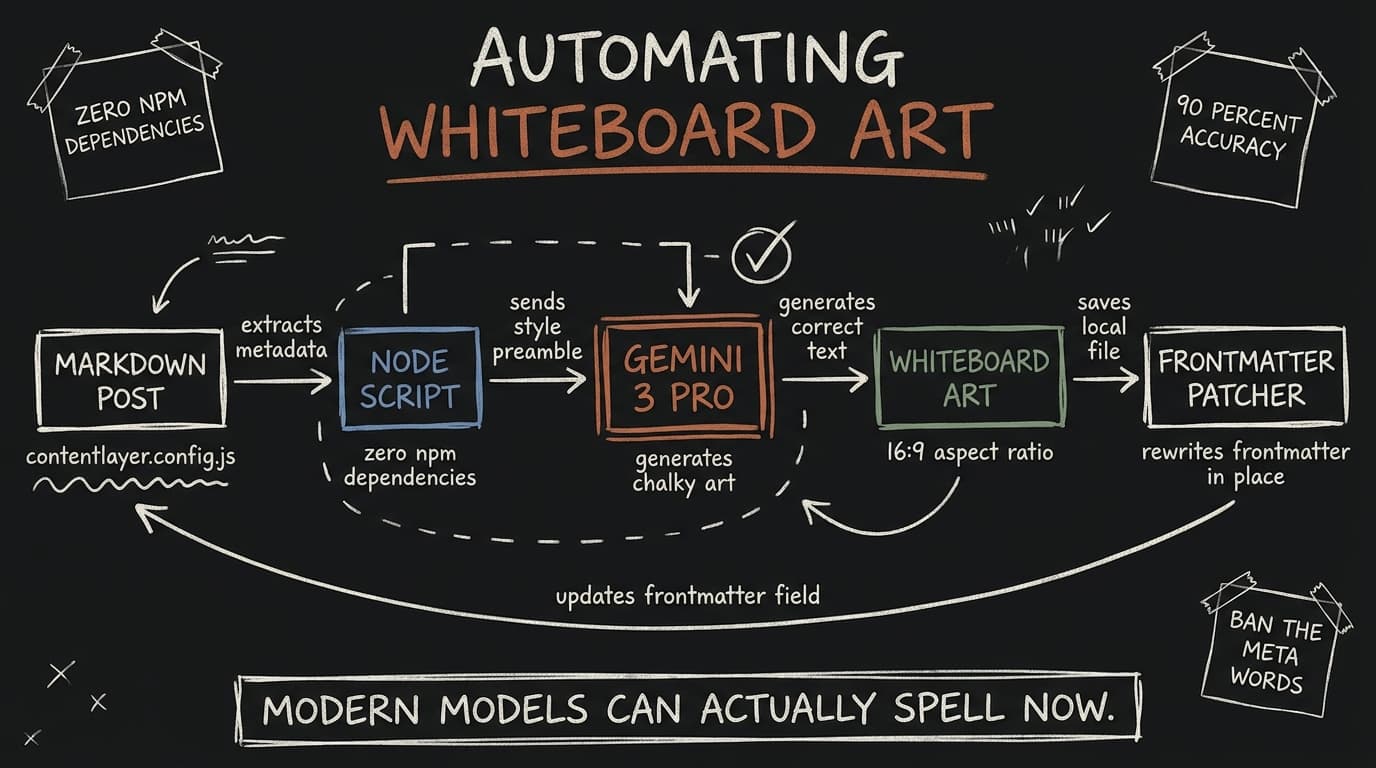
Seven of the eight published posts on this blog had no cover image. Worse, the image field
had been sitting in contentlayer.config.js the whole time, and nothing in the app rendered
it — one post set it, no component read it. A dead field and a text-only index.
So I wrote two scripts to fix it. The image one shipped a bug, and the bug was a sentence I wrote myself.
Two scripts, zero dependencies
Both live in a gitignored scripts/ folder — they're authoring tools, not part of the deployed
site, and nothing in the build depends on them. That constraint drove one useful decision:
no npm dependencies. Adding a package would write an entry into the committed
package.json for code that isn't in the repo, which is a broken checkout for anyone who
clones it. So: plain Node ESM, global fetch, a twelve-line .env.local parser, and a
frontmatter patcher that rewrites image: in place while preserving key order.
The image call itself is unremarkable:
const json = await call(model, {
  contents: [{ role: "user", parts: [{ text: prompt }] }],
  generationConfig: {
    responseModalities: ["TEXT", "IMAGE"],
    imageConfig: { aspectRatio: "16:9" },
  },
});
const image = (json.candidates?.[0]?.content?.parts ?? [])
  .find((p) => p.inlineData?.data);
The interesting part is the prompt. I wanted a consistent set — hand-drawn whiteboard architecture sketches, dark ground, chalky off-white marker, one burnt-orange focal element. Consistency comes from a fixed style preamble; variety comes from a per-post subject clause built out of the post's title, description, and tags.
The rule I got wrong
I ended that preamble with this:
CRITICAL: No readable words, no letters, no numbers. Where text would go, draw only illegible squiggle marks standing in for handwriting. Any legible character is a failure.
The reasoning felt obvious. Image models garble text. Everyone knows this. The post title already renders in HTML directly above the cover, so baked-in words are redundant at best and misspelled at worst.
That reasoning was three years stale. Nano Banana Pro ignored the ban on four of seven
covers — and spelled every word correctly when it did. Current benchmarks put Gemini 3 Pro
Image's text rendering in the mid-90s percent range, well past the point where "models can't
spell" is a useful heuristic. It drew CLAUDE.md, /clear, HARD GATE, SOFT GATE (LLM),
LANGGRAPH AGENT. All correct. All genuinely better than the squiggle-only covers sitting
next to them.
What actually broke
The constraint didn't produce a text-free set. It produced an inconsistent one, plus two real artefacts:
- On the Vertex RAG post, the model drew the literal word "annotation" — my own prompt wording ("include sketchy annotation marks") leaking straight into the art.
- On the system-design post it rendered "Queue" correctly once, then produced "Ungune" a few inches away.
That second one is the classic failure everyone expects. The first one isn't — it's a prompt-hygiene bug, and it's the more interesting of the two. When you tell a model not to draw text, you're still feeding it a page of English, and some of that English is describing the drawing itself. Half-suppressed instructions surface as vocabulary.
The fix: let it label, ban the meta-words
I inverted the rule. Instead of fighting for zero text, ask for a small amount of correct text, and explicitly ban the words that describe the drawing:
LABELS — the diagram is labelled, like a real whiteboard:
- Hand-print 3 to 6 SHORT labels (1-3 words each) in the same chalky marker.
- Every label must be spelled correctly and must come from the label list below.
- Any other place text would appear gets illegible squiggle marks, never real words.

ABSOLUTELY DO NOT draw any word describing the drawing itself. The words "annotation",
"label", "sketch", "diagram", "title", "summary", "topics", "focal", "subject" must
never appear in the image.
Then I regenerated all eight covers with --force. Both artefacts are gone, and the MacGet
cover now reads Swift Actor Engine, yt-dlp, Chunked HTTP — accurate to
the actual engine.
The trade-off I bought: the style preamble is now load-bearing across the whole set. Edit
it and you must regenerate everything, or the blog index looks like two different blogs. The
script takes --force for exactly this reason, and the README says so in bold.
The other thing that broke
The second script drafts posts from a topic string plus recent git log context. It works —
well-formed frontmatter, right voice, correct length. Its first output was also confidently
wrong about this very post: it invented "three hours of prompt-engineering loops," cited
Imagen 3 and FLUX (I used neither), and concluded with a CSS-overlay approach that is the
opposite of what I actually did.
Which is why that script hardcodes published: false and I don't let it override that. Web
research fills in external facts; it does not license a model to invent my Tuesday. A
drafting tool that can't be wrong isn't a drafting tool, it's a liability — the guardrail is
that a human reads it before the flag flips.
What's next
The covers are wired into the post header, the blog index, openGraph.images, and the
BlogPosting JSON-LD, with the existing generated OG route as fallback for any post without
one. Next up: teaching the image script to read the post body rather than just its
frontmatter, so the diagram reflects the architecture the post actually describes instead of
what the description implies.
If a cover on this blog contains a misspelled word I missed, tell me — I'd genuinely like to know which one.
Building in public — follow along on X.