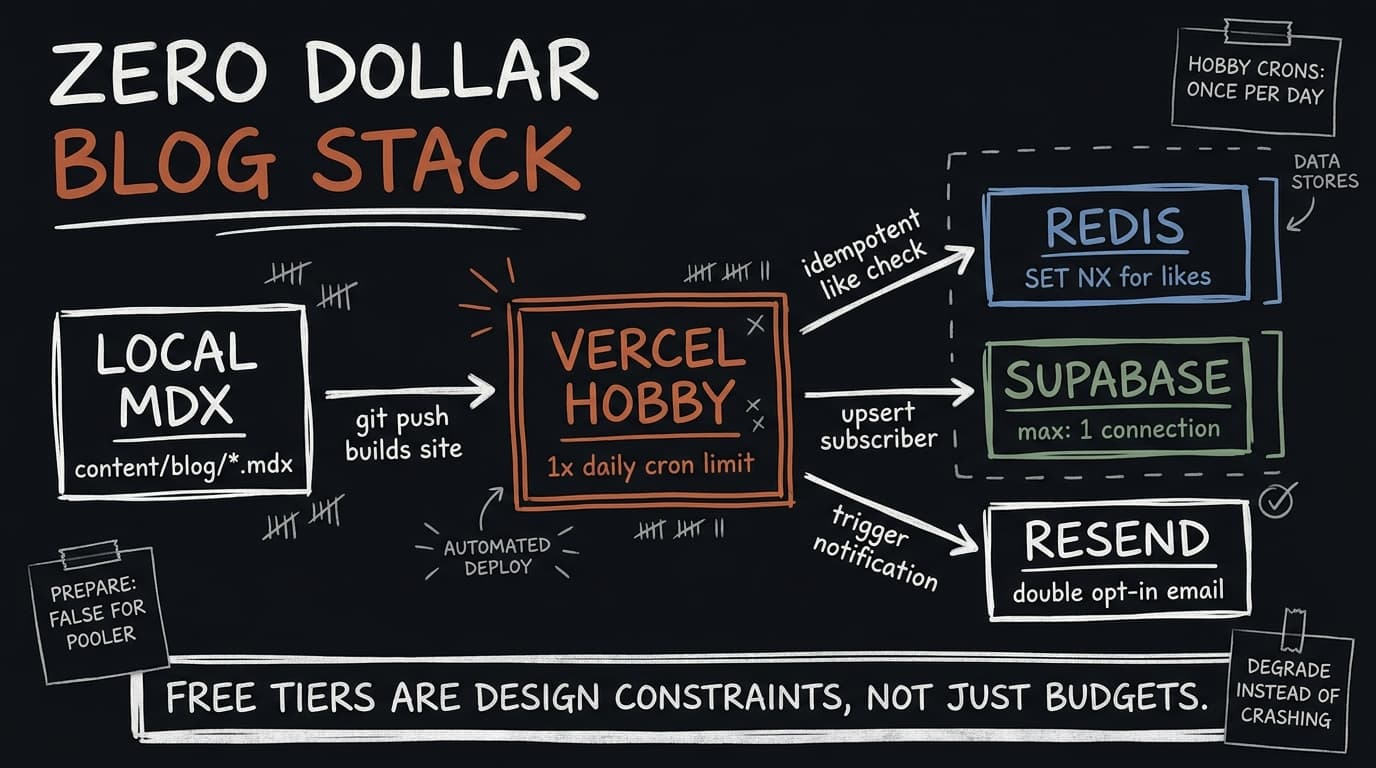
Writing in public only works if publishing is frictionless and free. The moment your blog needs a paid CMS, a mailing-list SaaS, or a database bill, you'll find reasons not to post. So when I upgraded the build-log on this site, I set one hard constraint: $0/month, running entirely on free tiers — and it had to feel like a real blog, not a folder of markdown. Likes, email subscribers, new-post notifications, the works.
Here's the whole stack, what each free tier covers, and the one limit that actually broke something.
The $0 stack for a portfolio build-log
- Content: MDX + Contentlayer. Posts are
.mdxfiles incontent/blog/, type-checked at build time. No CMS, no admin panel — a new post is a git commit. Free because it's just your repo. - Hosting: Vercel Hobby. The Next.js app, the API routes, and (with one caveat below) a cron job.
- Likes: Redis. A hosted Redis free tier, talked to over TCP with
ioredisfrom Node runtime routes. - Subscribers: Supabase Postgres. One
subscriberstable through the connection pooler. - Email: Resend. Confirmation emails and new-post notifications from an API route.
The theme across all of it: every integration is optional at runtime. If an env var is missing, the feature degrades instead of crashing:
export function getRedis(): Redis | null {
  if (globalForRedis.redis !== undefined) return globalForRedis.redis;
  const url = process.env.REDIS_URL;
  if (!url) {
    globalForRedis.redis = null;
    return null; // likes simply disable
  }
  // ...
}
That one pattern means anyone can clone the repo and run it with zero services configured. Likes hide, the subscribe form says "not configured yet," and the blog still ships.
Anonymous likes without accounts (or storing IPs)
I didn't want auth just for a like button. Instead each visitor gets a coarse fingerprint — a SHA-256 of IP + user-agent + a server salt, truncated. The raw IP is never stored:
return createHash("sha256").update(`${ip}|${ua}|${salt}`).digest("hex").slice(0, 24);One like per visitor is enforced with Redis SET NX — the set only succeeds the first time, so the increment is idempotent:
const first = await redis.set(dedupKey(slug, v), "1", "EX", 60 * 60 * 24 * 365, "NX");
if (first === "OK") count = await redis.incr(countKey(slug));
A fixed-window rate limit (20 actions/minute per visitor) sits in front, also just INCR + EXPIRE. Shared office NATs collapse into one visitor, and that's fine — the right bar for anonymous likes is "honest enough," not "perfect."
Email subscribers: double opt-in on Supabase + Resend
Subscribers live in one Postgres table with a status column (pending → confirmed → unsubscribed) and a UUID token that doubles as the confirm/unsubscribe link. The subscribe route upserts, then sends a confirmation email through Resend — double opt-in, because a list of unverified emails is a liability, not an asset.
Two Supabase-specific details cost me time:
prepare: falseon the postgres.js client, because the transaction pooler doesn't support prepared statements.max: 1connections per serverless instance, so a burst of invocations doesn't exhaust the pooler.
New-post notifications: a cron, a Redis set, and a seed run
Notifying subscribers is a daily cron hitting /api/notify. It diffs published posts against a Redis set of already-announced slugs and emails only the fresh ones. The detail I'm most glad I thought of: on the very first run it seeds the set with every existing post and sends nothing. Without that, deploying the feature would have blasted the whole back-catalog to every subscriber.
What broke: Vercel Hobby crons run once a day, period
I originally scheduled the notify cron every 30 minutes. Deploys started failing — Vercel's Hobby plan only allows cron expressions that run at most once per day, and it rejects anything more frequent at deploy time. The fix was a one-line change to 0 9 * * *, plus accepting the fine print: Hobby crons fire sometime within the scheduled hour, not on the dot, and schedules are UTC only.
For a blog notification that's completely fine — nobody needs a "new post" email within 30 minutes. But it's the kind of limit you want to know before you design around freshness. Free tiers are a design constraint, not just a budget.
What I learned
- Degrade, don't gate. Making every service optional (
nullclients, disabled features) kept the repo clonable and the deploys fearless. - Idempotency is cheaper than auth.
SET NXgave me one-like-per-visitor with no accounts, no sessions, no GDPR-shaped IP storage. - Seed before you notify. Any "announce what's new" job needs a first-run that marks everything as old.
- Read the free-tier fine print first. The Hobby cron limit was documented; I just hadn't looked until a deploy failed.
What's next
Per-post view counts are the obvious next Redis key, and I want a /api/notify dry-run mode so I can preview exactly who gets emailed before a post goes out. If you build a version of this — or know a cleaner free-tier trick for the notification cron — tell me.
This is a build log — I'm building these in public. Follow along on X or grab MacGet.