Anthropic shipped Claude Opus 5 on Thursday at $5/$25 per million tokens — half what Claude Fable 5 costs, with the claim that it approaches Fable across many tasks. Fable 5 itself is only six weeks old, launched June 9 as the first model in a "Mythos-class" tier sitting above the Opus line at $10/$50.
Two frontier tiers, six weeks apart, 2× price gap. For a multi-agent research desk the useful question isn't "which is better." It's which node in the graph gets which model — and that answer is mostly decided by constraints that have nothing to do with benchmarks.
Two caveats up front: Opus 5 is two days old, so nothing here is production-hardened throughput data. And "cheaper model, same quality" is a marketing claim until your own evals say otherwise. What follows is a routing plan and the migration hazards I found reading the API surface — not a benchmark.
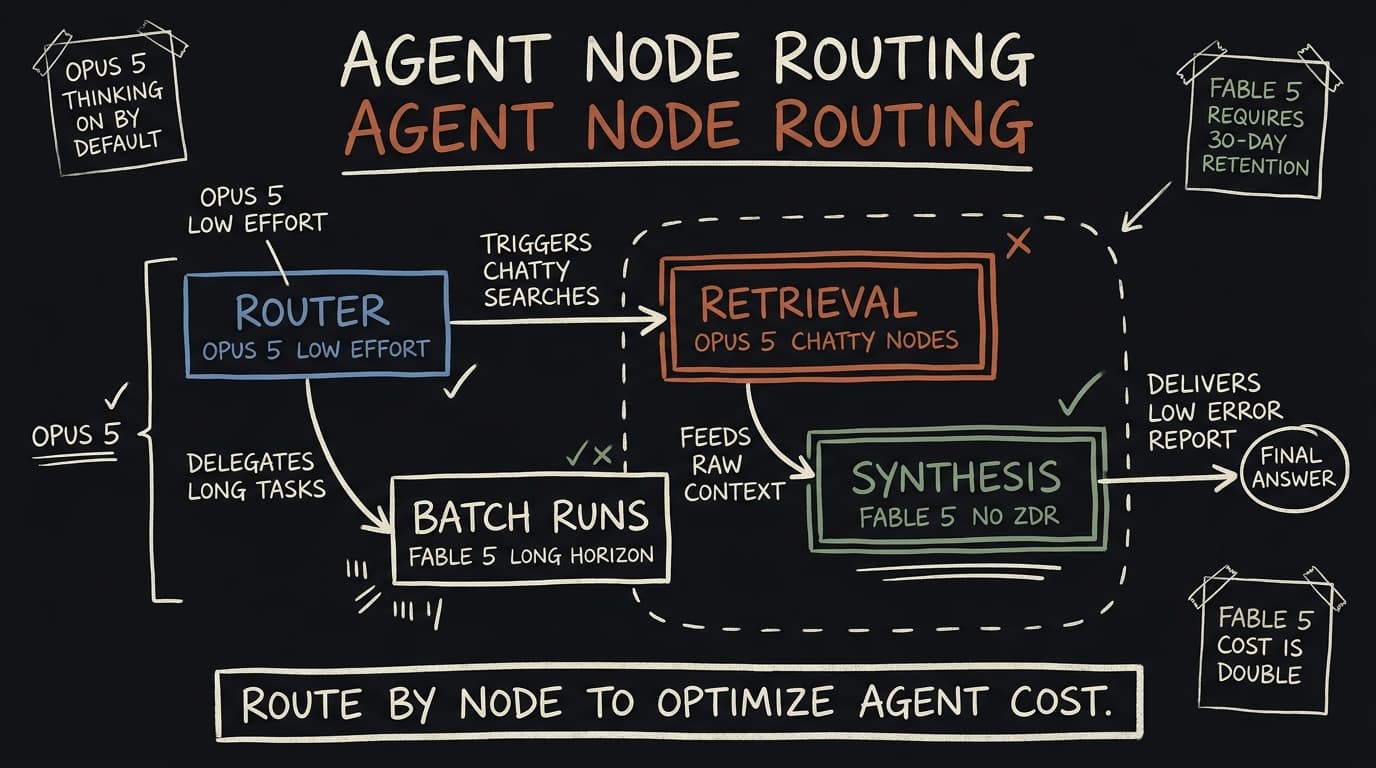
Route by node, not by project
A LangGraph agent isn't one workload. Mine has a planner, a set of retrieval nodes, a handful of gates, and a synthesis node that writes the analyst-facing answer. Those have wildly different failure costs. The planner being slightly worse means a suboptimal query plan. The synthesis node being slightly worse means a wrong number in front of someone making a trade.
So the split I'm starting from:
| Node | Model | Why |
|---|---|---|
| Router / classifier | Opus 5, effort: "low" | Cheap, bounded, no reasoning depth needed |
| Retrieval + tool nodes | Opus 5, effort: "medium" | High call volume — this is where 2× hurts |
| Synthesis / final answer | Fable 5 | Lowest error tolerance in the graph |
| Long-horizon batch runs | Fable 5 | Built for multi-day autonomous sessions |
The economics are the whole argument. Retrieval and tool nodes fire many times per query; synthesis fires once. Paying Mythos-tier rates on the chatty nodes is where the bill actually comes from, and it buys the least.
The change that will silently break your graph
Here's the migration hazard nobody's going to notice until the bill or the truncation shows
up. On Opus 5, thinking is on by default. On Opus 4.8 and 4.7, omitting the thinking
parameter meant no thinking. Same wire value, opposite default.
That matters because max_tokens is a hard cap on thinking plus response text. A node that
ran thinking-off on 4.8 and had max_tokens sized snugly around its answer now truncates
mid-response:
# Ran fine on Opus 4.8 — no thinking, 2K was plenty for a JSON verdict
resp = client.messages.create(
    model="claude-opus-5",   # <- only line changed
    max_tokens=2048,
    messages=[{"role": "user", "content": gate_prompt}],
)
# Now: thinking eats the budget, stop_reason == "max_tokens", JSON comes back half-written
The fix is either raising max_tokens or disabling thinking explicitly — but disabling has a
new constraint of its own. thinking: {"type": "disabled"} is only accepted at effort of
high or below; pair it with xhigh or max and you get a 400. It's validated per request,
so a later call that bumps effort fails even though earlier ones in the same conversation
worked.
Fable 5 goes further: thinking is always on and {"type": "disabled"} returns a 400 at
any effort. There's no thinking-off path at all. For a cheap high-volume classifier node,
that alone rules it out — which is a second, independent reason those nodes land on Opus 5.
The clause that decides it for regulated data
The constraint that actually settles this for anyone working with financial filings, health
data, or anything under a strict retention agreement: Fable 5 requires 30-day data
retention and is not available under zero data retention. An org configured for ZDR gets a
400 invalid_request_error on every Fable 5 request — a perfectly valid payload, rejected
on org policy.
If you hit an unexplained 400 with a request body you've triple-checked, check the org's retention configuration before you debug the payload. And if you're under ZDR, the model selection question is already answered: Opus 5 is your ceiling, and the routing table above collapses to one row.
I'd treat this as the first thing to check, not the last. It's a contract-level constraint, so it outranks every benchmark — no eval result changes whether the request is allowed through.
Delegation flips direction
One behavioural note worth knowing before you port prompts across. Opus 4.8 under-reached for subagents — the standard advice was to prompt it to delegate more. Opus 5 reverses this and delegates freely, which multiplies cost and latency: each subagent re-establishes context, re-explores, reports back, and the coordinator re-reads the report.
So any "delegate more" guidance you wrote for 4.8 should come out, and you probably want a hard cap in its place. Same story with verification — Opus 5 checks its own work unprompted, so instructions telling it to verify now cause redundant work. That one's a delete, not a rewrite.
What's next
I'm running the routing table above against my own eval set before committing to it — the
node boundaries are a hypothesis, and the "Opus 5 approaches Fable" claim needs to survive
contact with actual filings before I trust it on the synthesis node. The thing I most want to
measure is whether effort: "medium" on retrieval nodes holds quality, since that's where
most of the token spend lives.
If you've already got Opus 5 traffic in a real agent graph, I'd genuinely like to hear where the routing line landed for you — especially if you found a node where the cheaper tier visibly wasn't enough.
Building in public — follow along on X.