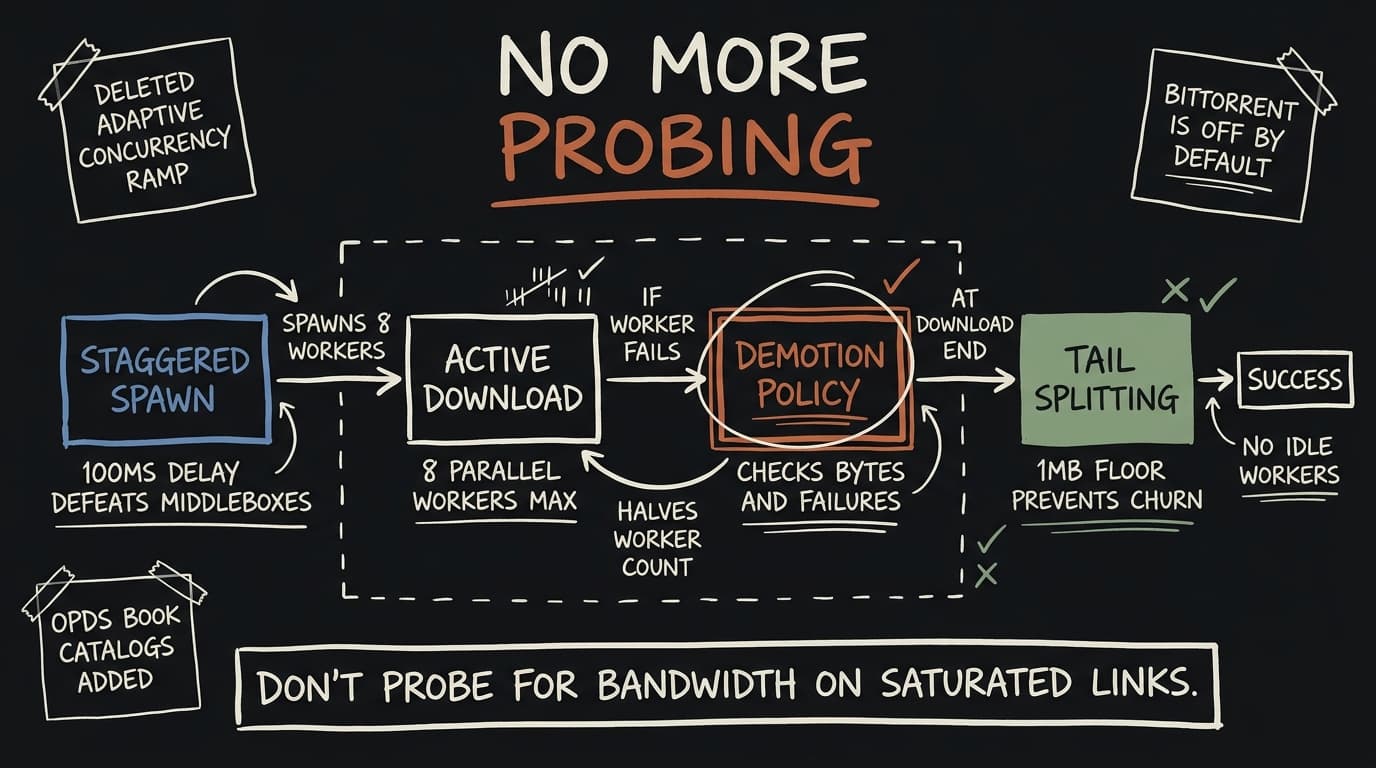
In 1.1.0 I shipped "adaptive concurrency" as a headline feature of MacGet: a download opens 4 connections, probes upward one at a time, and keeps each new connection only if aggregate throughput improves by 15%. It sounded principled. It was also the reason MacGet was slower than it should have been on exactly the connections where it had the most to gain.
1.3.0 deletes it.
The heuristic that measured the wrong thing
The bug is in the premise. The probe asks "did adding a connection make this faster?" and treats no as evidence the connection is useless. But once a link is saturated, "no improvement" is the expected reading for every additional connection — the pipe is already full, so of course the number doesn't move. The probe couldn't distinguish "this host refuses more connections" from "you already have all the bandwidth there is," and it read both as failure.
So it settled low precisely when the extra connections were free, and the users who'd benefit most from a multi-threaded downloader — fat pipe, per-connection-throttling server — got the most conservative behavior.
The fix isn't a better probe. It's not probing. A download now opens at its full effective thread count immediately, staggered 100 ms apart:
/// Delay between consecutive worker spawns. Anti-abuse middleboxes pattern-
/// match a burst of N TCP SYNs from one IP; staggering defeats that. With
/// the default 8 workers this is 700 ms to fully spawn.
private static let spawnStaggerNanos: UInt64 = 100_000_000  // 100 ms
The stagger isn't throughput tuning — it's evasion. Eight simultaneous SYNs from one IP is a recognizable shape to anti-abuse middleboxes. Spread over 700 ms, it isn't.
Backing off on evidence instead of guesswork
Removing the ramp only works if the downward path is trustworthy, because now there's no gentle approach to hide behind. The old demotion logic counted failures and shrank. The problem: MacGet persists what it learns, so blaming a host for your Wi-Fi dropping leaves a permanent cap on a server that did nothing wrong.
DemotionPolicy now demands a second signal — bytes still moving:
static func shouldDemote(
    failureCount: Int,
    throughputBytesPerSecond: Double,
    threshold: Int = threshold,
    healthyThroughput: Double = healthyThroughputBytesPerSecond
) -> Bool {
    guard failureCount >= threshold else { return false }
    return throughputBytesPerSecond >= healthyThroughput
}
A hostile host RSTs some workers while serving the rest at full speed — failures and throughput. A dead local link fails every worker at once and throughput collapses to zero. Same failure count, opposite diagnosis. Four no-progress attempts in 10 seconds while bytes flow halves the worker count; the same four with nothing moving is just the retry path doing its job.
Learned caps now also expire after 7 days and can be cleared in Settings › Network. A cap mislearned during an outage heals itself instead of throttling that host forever.
The endgame: nobody idles
With work-stealing chunking there's still a tail — the point where every remaining piece is already assigned, so a freed worker has nothing to steal. It used to just idle while the slowest chunk set the finish time. Now it splits the largest in-flight piece in half, floored at 1 MB:
/// Splitting cancels a live worker and reconnects, and a TLS handshake
/// costs 100–300 ms — not worth spending to rescue 64 KB.
static let defaultMinimumSplitBytes: Int64 = 1024 * 1024
That floor is the whole design. Without it, every freed worker splits ever-smaller tails and churns
connections through the last second of the download. The selection heuristic is bytes remaining, not
time remaining — which is technically wrong (a fast worker that started late can hold more bytes
than a slow one nearly done), and I shipped it anyway. Tracking per-chunk speed puts more state on
the hot path, and at the tail the two measures mostly agree. DownloadInspection.splitCount is
exposed specifically so I can find out if I'm wrong.
BitTorrent, off by default
Magnet links and .torrent files now run in the same queue as everything else — same concurrency
limit, same pause/resume, same quiet-hours scheduling. Two deliberate constraints:
- Off by default. Turning it on shows a one-time explanation that BitTorrent uploads as well as downloads, opens a listening port, and makes your IP visible to the swarm. That's not a footnote.
- Seeding is bounded — ratio 1.0 or 60 minutes, whichever comes first. MacGet does not search for or index torrents.
The engine is aria2, and it is not bundled. Unlike the static ffmpeg/yt-dlp builds, aria2
links against five system libraries, so MacGet installs it via Homebrew on first use. That's a real
regression against the zero-setup promise I made in the engine post
— and the trade I took, because it also means MacGet never redistributes GPL software.
Book catalogs over OPDS
⇧⌘B opens a browser for Project Gutenberg (~75k public-domain titles) and the Internet Archive; any
OPDS feed works, including your own Calibre server. Files land as Title - Author.epub instead of
the catalog's 2701.epub. DRM-wrapped, priced, and loan-only editions are shown but never fetched.
Neither headline catalog actually goes through OPDS. Gutenberg's own feed returns one sub-feed per
book rather than direct download links, so MacGet reads Gutendex instead. And the Internet Archive
retired its OPDS BookServer entirely — bookserver.archive.org no longer resolves — so that path is
IA's JSON search and metadata APIs. The generic OPDS support is real; the two catalogs people
actually want are the exceptions to it.
The bug that made all of this worth shipping
Media downloads from logged-in pages were 403ing, and the failure was maddening because the probe
succeeded and the download that followed died. Cookies captured by the extension were handed to
yt-dlp as --add-header "Cookie: …", which applies them to every request — including the CDN
fetch. YouTube rejects an authenticated googlevideo.com request carrying no proof-of-origin token.
The cookies weren't missing; they were being sent somewhere they shouldn't be.
Cookies now go through a domain-scoped Netscape cookie jar, deliberately scoped so it covers the page
host and its subdomains but not googlevideo.com.
What's next
Homebrew cask install (brew install --cask suryansh-codes2209/macget/macget) is on main but
didn't make the 1.3.0 tag — it goes out with the next release. After that: notarization, so the
"Open Anyway" dance on first launch finally goes away.
If you're on a fast connection, I'd genuinely like to know whether removing the ramp helped or whether some host punishes you for it — that's the failure mode I traded for, and I don't have enough machines to find it myself. MacGet is here; source and issues on GitHub.
Building in public — follow along on X.