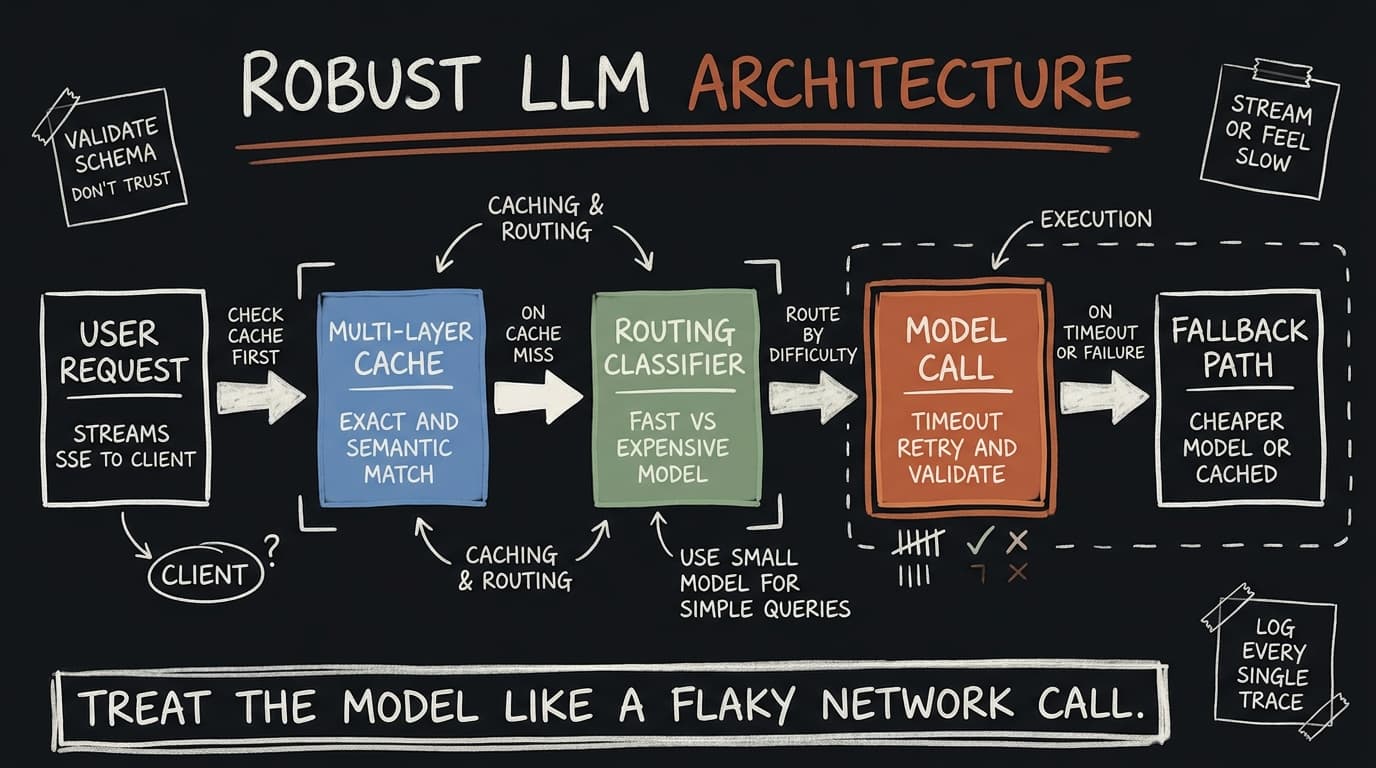
An AI feature is a distributed system with one very expensive, very slow, occasionally-wrong dependency: the model. Once you frame it that way, the system design gets a lot clearer. Here are the notes I keep pinned.
Treat the model like a flaky network call
Because it is one. It times out, rate-limits, returns malformed JSON, and costs money per request. So it gets the same treatment as any unreliable dependency:
- Timeouts and retries with backoff on every call.
- Schema validation on every response — never
json.loadsand hope. - A fallback path — a cheaper model, a cached answer, or an honest "try again."
async def call_model(prompt: str) -> Result:
    for attempt in range(3):
        try:
            raw = await client.generate(prompt, timeout=20)
            return Schema.model_validate_json(raw)   # validate, don't trust
        except (TimeoutError, ValidationError):
            await asyncio.sleep(2 ** attempt)
    return FALLBACK
Stream, or feel slow
A 6-second response that streams feels faster than a 2-second one that blocks. Token streaming is the single highest-ROI UX change for any LLM feature. On the backend that means Server-Sent Events (or a WebSocket) from FastAPI straight through to the client — no buffering the whole completion server-side.
Cache aggressively, at three layers
Most "AI cost problems" are really "we recompute the same thing" problems.
- Exact-match cache on (prompt, model, params) — free wins for repeated queries.
- Semantic cache — embed the query, reuse an answer if a near-identical one exists.
- Component cache — cache the retrieval and the embeddings, not just the final answer.
Route by difficulty, not by default
Sending every request to your most capable model is how bills explode. Route: cheap/fast model for classification, extraction, and simple rewrites; the big model only for the hard reasoning. A tiny classifier up front pays for itself in a day.
Make it observable or you're flying blind
Log the full request/response, token counts, latency, cost, and which path (cache hit? fallback? which model?) served each call. When quality drifts — and it will — this trace is the only thing that tells you why. I treat "no trace" as a production incident waiting to happen.
Boring infrastructure, interesting product
Docker, a queue for the slow jobs, Cloud Run that scales to zero, health checks, and a budget alert. None of it is exciting, and that's the point — the interesting part should be the product, not the 3am pages. The goal is an AI feature that's fast, cheap, and boring to operate.
Build log from shipping AI systems in public. More at /blog — or say hi on X.