The integration nobody wants to write is the one where your product is the thirteenth checkbox in someone else's settings page. You build a REST API, you document it, and then you wait for a partner engineer to care enough to wire it up. That was the deal for a decade, and the deal was bad.
MCP changes the direction of that work. You expose one server, and every MCP-compatible client — Claude, Cursor, VS Code, whatever ships next quarter — can drive your product without you writing a line of client code. The connector is the integration. That's genuinely a better deal.
What I didn't expect is that the protocol turns out to be the easy half. The hard half is the payload.
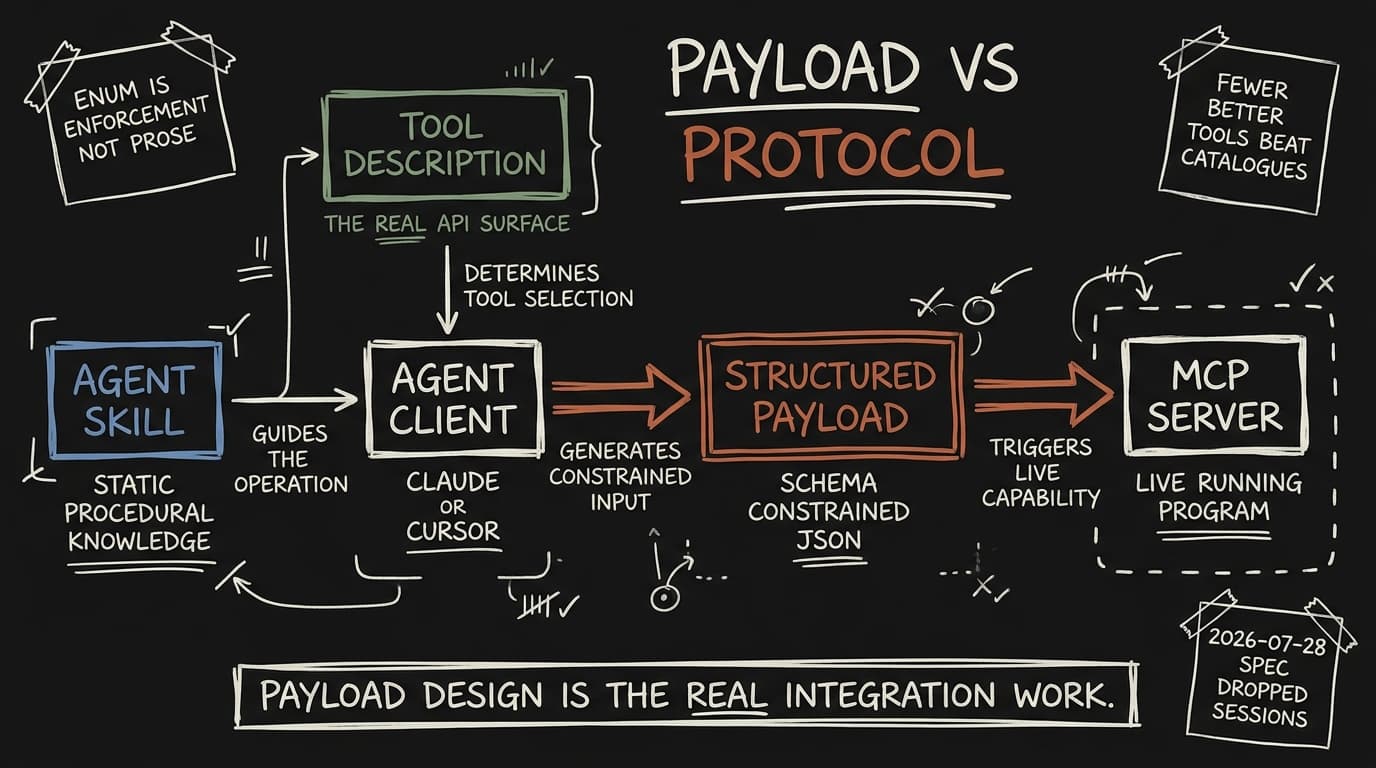
MCP and skills solve different halves
The distinction that finally stuck for me:
- An MCP server is a running program. It's capability — query this, fetch that, change this state. It's live, it can fail, it needs an owner and a hosting bill.
- A skill is static text the agent reads when a task matches. It's procedural knowledge — how we do this here, conventions, the order of operations. It costs nothing to run and it works offline.
The mistake is treating them as competitors. They're not: a skill without tools is a nicely-worded suggestion, and tools without a skill are a drawer of unlabelled instruments. Ask what you're short on. Short on capability — the agent can't reach the thing — build the server. Short on knowledge — the agent can reach it but keeps doing it wrong — write the skill.
The /build-log command that generated this post is the skill half. It has no special powers. It just encodes the sequence I'd otherwise re-explain every time.
The payload is where it actually breaks
Here's the thing I keep relearning, and I relearned it today on a problem that has nothing to do with MCP.
This blog's cover images are generated. The old pipeline fed the image model a post's title and tags and asked for "a diagram." The results were vague — not because the model was weak, but because I'd handed it a payload with nothing in it to be specific about. It had no material, so it produced mush.
The fix wasn't a better prompt. It was putting a structured payload in between. A cheap text pass now reads the post body and returns a schema-constrained brief — every string that will appear in the image, and nothing else:
const SCHEMA = {
  type: "OBJECT",
  properties: {
    title: { type: "STRING" },
    nodes: {
      type: "ARRAY",
      items: {
        type: "OBJECT",
        properties: {
          label: { type: "STRING" },
          note:  { type: "STRING" },
          color: { type: "STRING", enum: ["white", "orange", "blue", "green"] },
        },
        required: ["label", "note", "color"],
      },
    },
    arrows: { /* from, to, caption */ },
    banner: { type: "STRING" },
  },
  required: ["title", "nodes", "arrows", "banner"],
};
Then the consuming call ends with that payload flattened into an explicit allowlist and one instruction: render these, invent nothing.
That's the same shape as a well-designed MCP tool. A constrained schema so the caller can't hand you nonsense, an enum instead of a free string wherever the set is actually finite, and a return value specific enough that the next step doesn't have to guess.
What broke, and what it taught me
Two things, and they generalise.
The allowlist leaked. Despite an explicit "invent nothing," one render added annotations that weren't in the brief. They happened to be correct and useful, so I kept them — but the lesson is that a constraint stated in prose is a preference, not a guarantee. If it matters, it belongs in the schema where it can be validated, not in the instructions where it can be interpreted. The same is true of an MCP tool: enum is enforcement, "please pass one of the following" is a wish.
Descriptions are the real API surface. An agent picks your tool based on its description and nothing else. It won't read your docs site, and it can't ask a clarifying question. A description that reads fine to a human — "manages resources" — is unusable to a caller that has to decide, right now, between it and four siblings. The rewrite that fixed my brief pass wasn't structural; it was replacing every vague field instruction with a bounded one ("2 to 5 words", "must exactly match a label above").
I also validate on the way back in, because the model will drift: exactly one accent element enforced, references that don't resolve dropped, a hard error under three nodes. Trust the schema, verify the payload.
The trade-off I took
I went with remote HTTP and an API key header rather than OAuth. It's honestly the worse choice for end users — they paste a key into a config file instead of clicking through a consent screen — and I'd steer a real product toward OAuth, which is the direction the spec is clearly pushing. I took the key because it was a day of work instead of a week, and I wanted the thing running before I optimised the front door.
Worth knowing if you're starting now: the 2026-07-28 spec made the protocol core stateless and dropped the session header, formalised extensions, and put the legacy HTTP+SSE transport on a year-long offramp. Build against the current spec. The migration is real work you can simply not incur.
What's next
I want to collapse the tool surface. My instinct was to expose everything and let the agent sort it out, which is exactly backwards — every tool definition is context spent before the agent has done anything, and more choices makes the choosing worse. Fewer, better-described tools beat a complete catalogue.
If you've shipped an MCP server and found a tool-description pattern that reliably stops mis-selection, I'd like to hear it — that's the part I'm still guessing at.
This is a build log — I'm building these in public. Follow along on X or grab MacGet.