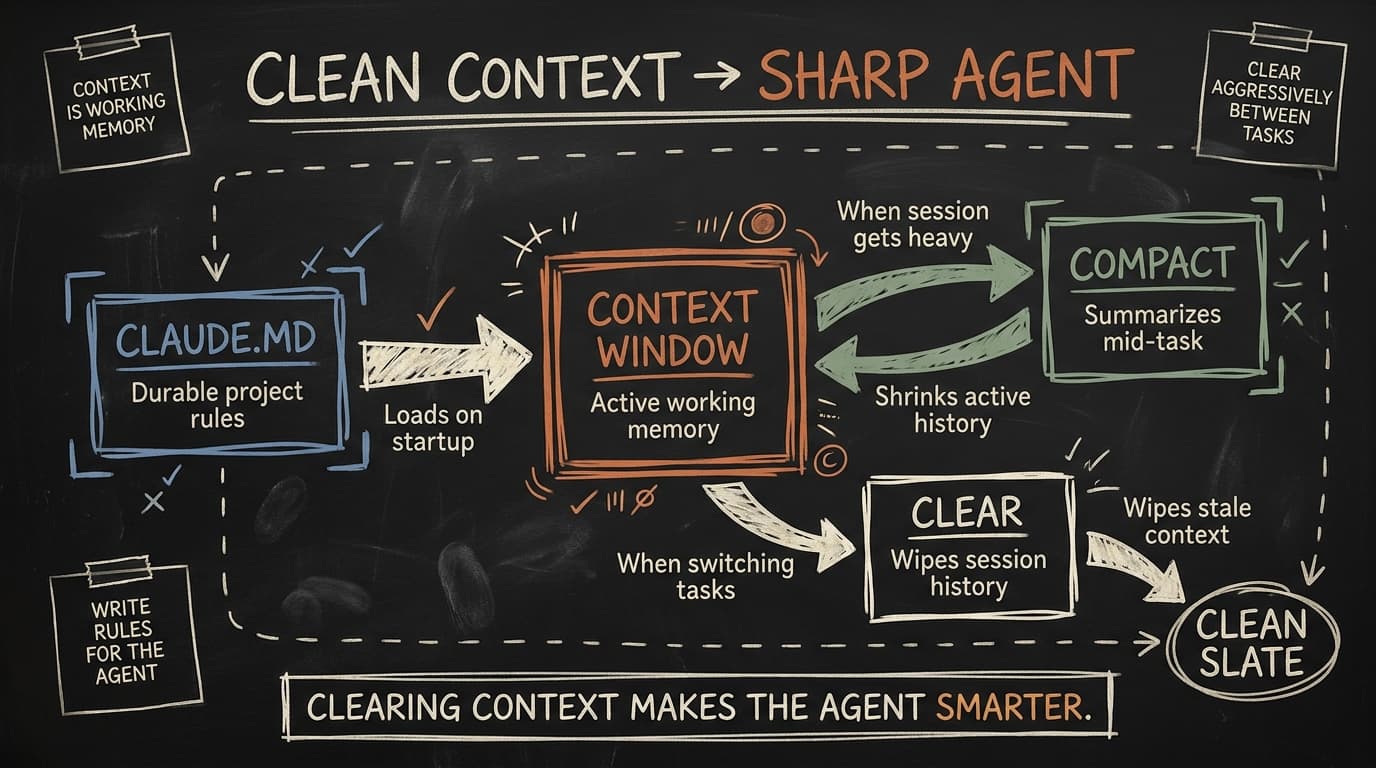
The thing nobody tells you about coding with an AI agent is that the model isn't the bottleneck — the context is. A long session doesn't fail because the model got dumber. It fails because you let the window fill up with three unrelated tasks, a stale file tree, and a debugging thread you abandoned an hour ago. The model is now doing its best to reconcile all of it at once, and it drifts.
Most of my Claude Code output quality comes down to boring context hygiene, not clever prompting. Here's the actual workflow I run.
Treat context like a resource, not a transcript
The mental model that fixed this for me: the context window is working memory, not a chat history. Everything in it is being re-read on every turn. If it's not helping the current task, it's actively hurting — competing for attention, nudging the model toward whatever I was doing before.
So I manage it deliberately with two commands.
/clear between unrelated tasks — aggressively
When I finish a task and move to something unrelated, I /clear. Every time. Fixing a theme bug, then writing a blog post, then touching an API route — those are three different jobs. Carrying the theme-bug context into the blog post gives me a model that keeps pattern-matching on CSS tokens when I want it thinking about prose.
The tell that I should have cleared already: the model starts referencing files or decisions that have nothing to do with what I just asked. That's stale context leaking. /clear is cheap. A confused 40-message session is not.
The one thing that survives a clear is CLAUDE.md (more below) — so clearing costs me almost nothing, because the durable project knowledge is on disk, not in the transcript.
/compact mid-task, when I need continuity but not the noise
/clear is for switching tasks. /compact is for staying on one that's gotten long. When I'm deep in a multi-step change — say, tokenizing every page for a dual light/dark theme — I don't want to lose the thread, but I also don't need the full verbatim history of every file I read forty turns ago.
/compact summarizes the session down to what matters and keeps going. I reach for it when I can feel the session getting heavy but I'm not done. The trick is timing: compact at a natural checkpoint — a finished sub-step — not in the middle of a half-applied edit, so the summary captures a clean state.
Rough rule I follow:
- Switching tasks? →
/clear - Same task, getting long? →
/compactat the next checkpoint - Model drifting or contradicting itself? → I've waited too long on one of the above
A CLAUDE.md that the model actually reads
/clear only works because I don't rely on the transcript for project knowledge. That lives in CLAUDE.md, which gets loaded into every session automatically. If it's vague, every fresh session starts by rediscovering how the project works. If it's precise, the model is productive on turn one.
Mine is not a README. It's an operating brief written for the agent — commands, architecture, and the specific gotchas that would otherwise cost me a bad diff. A real slice from this portfolio's file:
**Project data — static:** Projects live as a typed array in
`app/data/projects.ts` (no MDX, no Redis, no view counts).
Edit that file to add/remove projects.

**Design tokens:** `global.css` defines root CSS vars (`--bg`,
`--surface`, `--border`, `--text`, `--accent`) that
`tailwind.config.js` wires up as `bg`, `surface`, `line` colors.
Use Tailwind classes like `border-line`, `bg-surface`, and
`font-mono` rather than hardcoding these values.
That second paragraph exists because the model kept hardcoding hex values instead of using the token classes. One sentence in CLAUDE.md fixed it permanently, across every future session. That's the pattern: when I correct the same mistake twice, it becomes a line in CLAUDE.md instead of a correction I have to repeat forever.
What earns a spot in the file:
- The exact commands (
pnpm fmtuses Rome and applies unsafe fixes — the model needs to know that) - Architecture that isn't obvious from the file tree ("blog is Contentlayer MDX, projects are a static array")
- Conventions I care about (use design tokens, not raw values)
- Honest constraints ("there are no tests in this project" — so it stops looking for them)
What doesn't: anything already obvious from the code, and anything that's really about one task. That belongs in the session, not the standing brief.
The stuff on disk that survives every /clear
Two more things make the clear-often approach work, because they persist outside the transcript:
- Custom slash commands. This post came out of a
/build-logcommand I wrote — a.claude/commands/build-log.mdfile that tells the agent how to gather real context from git history and write in my voice. Repeatable workflows become one word instead of a paragraph I retype. - A memory file. Facts that outlive a session — project goals, a gotcha I hit last week — go into a memory index the agent reads on startup. Same principle as
CLAUDE.md: durable knowledge belongs on disk, not in a transcript I'm about to clear.
What I learned
The counterintuitive part is that clearing more often makes the agent smarter, not dumber. I used to hoard context, afraid to lose something. That gave me long, muddy sessions where the model hedged and drifted. Now the loop is: sharp CLAUDE.md, short focused sessions, /clear between jobs, /compact within a long one. The model spends its attention on the task in front of it instead of the archaeology behind it.
None of this is clever. It's just refusing to treat the context window as infinite — because it isn't, and the model pays for every token of noise I leave in it.
What's next
I want to get more disciplined about pushing recurring corrections into CLAUDE.md the first time instead of the second, and to build out a couple more custom commands for the workflows I repeat most. If you've got a context-management habit that works for you — or you think I'm wrong about clearing this aggressively — I'd genuinely like to hear it.