Most "AI agent" demos fall apart the moment they leave the notebook. They loop forever, call the wrong tool, or quietly hallucinate a number into a report nobody double-checks. Shipping one to production is a different sport — it's less about clever prompts and more about plain engineering discipline.
Here's the structure I keep coming back to for the financial-research agents I build.
Model the state explicitly
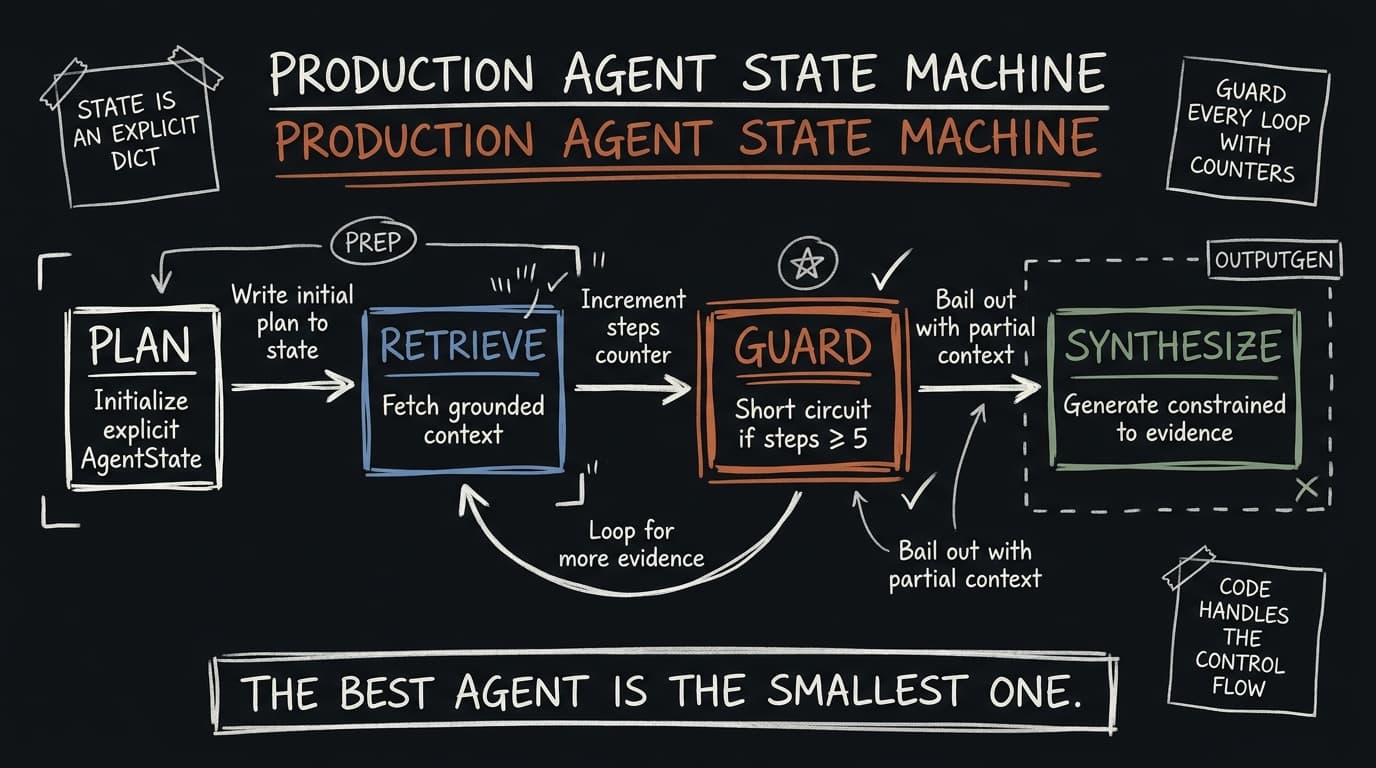
The single biggest upgrade is treating the agent as a state machine, not a chat loop. In LangGraph that means one typed state object that every node reads from and writes to:
from typing import TypedDict, Annotated
from operator import add

class AgentState(TypedDict):
    question: str
    plan: list[str]
    evidence: Annotated[list[str], add]   # accumulates across nodes
    answer: str | None
    steps: int
When the state is explicit, you can log it, snapshot it, replay it, and reason about exactly what the agent knew at each step. When it's buried inside a free-form message history, you can't.
Keep nodes small and boring
Each node should do one thing: plan, retrieve, reason, critique, or format. A node that "retrieves data and reasons and writes the report" is impossible to test or debug. Small nodes give you clean seams:
graph.add_node("plan", plan_node)
graph.add_node("retrieve", retrieve_node)
graph.add_node("synthesize", synthesize_node)
graph.add_conditional_edges("retrieve", enough_evidence, {
    True: "synthesize",
    False: "plan",   # loop back, but with a guard (see below)
})
Guard every loop
Any edge that can cycle needs a hard limit. LLMs are perfectly happy to retrieve the same document forty times. I put a steps counter in the state and short-circuit:
def enough_evidence(state: AgentState) -> bool:
    if state["steps"] >= 5:
        return True  # bail out, answer with what we have
    return len(state["evidence"]) >= 3
"Bail out gracefully with partial evidence" beats "loop until the timeout" every single time in production.
Decide what the model is not allowed to decide
The tempting failure mode is to hand the model everything and let it orchestrate. Don't. The model is good at language and judgment; it's bad at control flow and math. So:
- Routing between well-known steps → deterministic code / conditional edges.
- Calculations → a real tool, never the model's arithmetic.
- Which tool, with what arguments → the model, but validated against a schema before you run it.
Every time I moved a decision from the prompt into code, reliability went up.
Ground, then generate
For anything factual, retrieval comes first and generation is constrained to the retrieved context. The prompt literally says "answer only from the evidence below; if it's not there, say so." Pair that with citations in the state and you get reports you can actually trust — and audit.
What I'd tell past-me
Start with the dumbest graph that works — plan → retrieve → answer — and add nodes only when a real failure demands one. Every node is a thing that can break at 3am. The best agent is the smallest one that gets the job done.
This is a build log — I'm building these in public. Follow along on X or grab MacGet.