The number you need is almost never in the paragraph. It's in a bar chart on page 34, a footnote to a table, or a line item in a cash-flow statement that got flattened into mush the moment a text-only parser touched the PDF. That's the core problem with building research agents over financial documents: the corpus is multimodal, and pretending it's plain text is how you ship an agent that confidently cites the wrong revenue figure.
The fix isn't a cleverer prompt — it's agentic RAG done with discipline: an agent that plans, retrieves, checks its own evidence, and only then answers. I build these with LangChain and LangGraph for orchestration — but I stopped building the retrieval layer myself. I hand ingestion and retrieval to Vertex AI's RAG Engine on GCP. Here's why, and what it cost me to get retrieval quality and groundedness where I needed them.
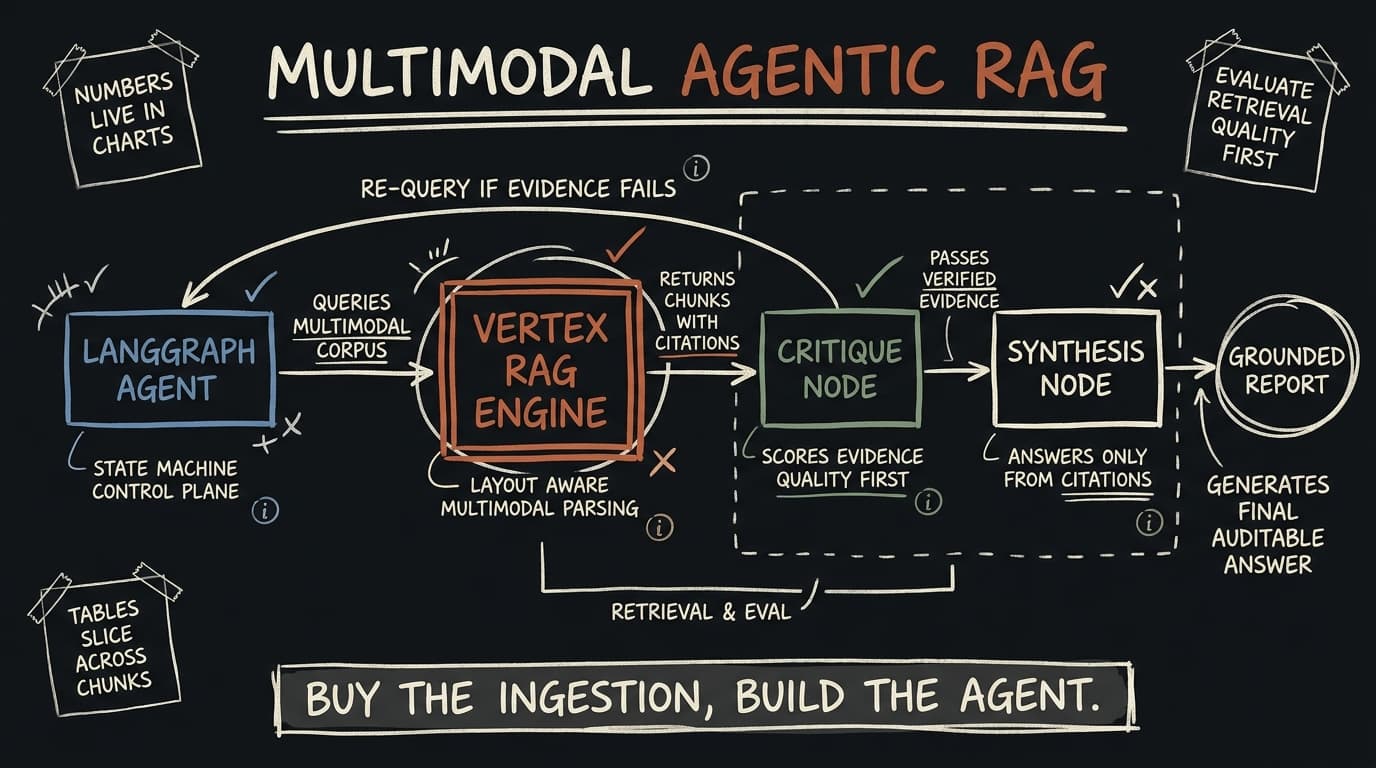
The split: LangGraph is the control plane, Vertex is the data plane
I've written before about treating an agent as a state machine — explicit state, small nodes, guarded loops. That still holds. What changed is where the evidence comes from.
The division of labor I settled on — a clean control-plane / data-plane split:
- LangGraph is the control plane: plan → retrieve → critique → synthesize, with a typed state object and hard loop guards.
- LangChain owns the model plumbing — prompts, structured output, the tool interface.
- Vertex AI RAG Engine is the data plane: it parses the PDFs (including charts and tables), chunks them, embeds them, and serves grounded results with citations.
The decision that mattered: I did not want to own the ingestion pipeline. Parsing a 200-page filing with embedded charts, merged table cells, and scanned exhibits into clean, retrievable chunks is its own multi-month project. Vertex's managed multimodal ingestion does that layout-aware parsing for me, so my effort goes into the agent, not into rebuilding a document parser I'd only ever half-finish.
Ingestion is one call, not a pipeline
The whole reason to reach for the managed engine is that corpus setup collapses to a few calls instead of a parsing service:
from vertexai.preview import rag

corpus = rag.create_corpus(display_name="filings-2026")

rag.import_files(
    corpus.name,
    paths=["gs://research-corpus/filings/"],   # PDFs with charts + tables
    chunk_size=512,
    chunk_overlap=100,
)
No OCR wiring, no table-extraction heuristics, no embedding job to babysit. It ingests the bucket and gives me a corpus I can query.
Retrieval is just a node
Inside the graph, retrieval is a single boring node. It queries the corpus and writes the results — with their source citations — into the agent's state, so every downstream claim is auditable:
def retrieve_node(state: AgentState) -> dict:
    response = rag.retrieval_query(
        rag_resources=[rag.RagResource(rag_corpus=CORPUS)],
        text=state["query"],
        similarity_top_k=8,
        vector_distance_threshold=0.5,
    )
    chunks = [
        {"text": c.text, "source": c.source_uri}
        for c in response.contexts.contexts
    ]
    return {"evidence": chunks}   # accumulates into typed state
That's the clean part. The synthesize node then runs under the usual constraint — answer only from the evidence below; if it isn't there, say so — and carries the citations through to the final report.
What broke: retrieval quality on multimodal
Managed ingestion gets you a corpus fast. It does not hand you good answers for free. Retrieval quality was the entire fight, and it broke in ways text-only RAG never does:
- Tables got sliced across chunks. A fixed chunk boundary would cut a table so a row's label landed in one chunk and its value in another. The model would then confidently pair the wrong label with the wrong number. Tuning
chunk_sizeand overlap helped at the margins, but the real fix was layout-aware parsing — using the Document AI Layout Parser so tables and their headers stay intact as a unit before they're embedded, instead of letting a naive splitter cut through them. - Charts came back as captions. Retrieval would surface the text around a chart — "Figure 4: quarterly revenue" — without the values the chart encodes. If the datapoint only exists visually, a caption match looks relevant and answers nothing.
- Top-k was a tradeoff, not a setting. Low
similarity_top_kmissed the one chunk with the real number; high top-k flooded the context with near-duplicate boilerplate and diluted the signal. I landed on retrieving wider, then adding a critique node that scores whether the evidence actually contains the answer before synthesis — and loops back to re-query (with a guard) if it doesn't.
The pattern that saved me: treat "did retrieval actually find the answer?" as an explicit, model-checked step, not an assumption. That extra node caught most of the confident-but-wrong failures before they reached a report.
What I learned
Buy the boring, hard, undifferentiated part; build the part that's actually yours. Layout-aware multimodal ingestion is boring and hard — perfect to buy. Deciding when the agent has enough evidence to answer is the actual product, and no managed service will do it for you.
And measure retrieval on your worst documents, not your cleanest. A text-heavy quarterly summary makes any RAG stack look great. The scanned exhibit with a chart and a merged-cell table is where you find out whether it works.
What's next
The teams winning at RAG right now built their evaluation infrastructure first, and I'm catching up on that. I'm building retrieval evals specifically for the table and chart cases — a small labeled set of "the answer is only in this figure" questions that scores both retrieval quality (did the right chunk show up?) and groundedness (did the answer actually use it?), so I can catch regressions when I tune chunking or swap models. If you've built agentic RAG over financial or scientific PDFs and found something that helped with chart-level retrieval, I'd genuinely like to hear it.
This is a build log — I'm building these in public. Follow along on X or grab MacGet.